Maximize Efficiency & ROI with Dymaxel’s Odoo Implementation Services
Looking for expert Odoo Implementation Services? Dymaxel specializes in Odoo ERP configuration and customization to help your business achieve maximum ROI.

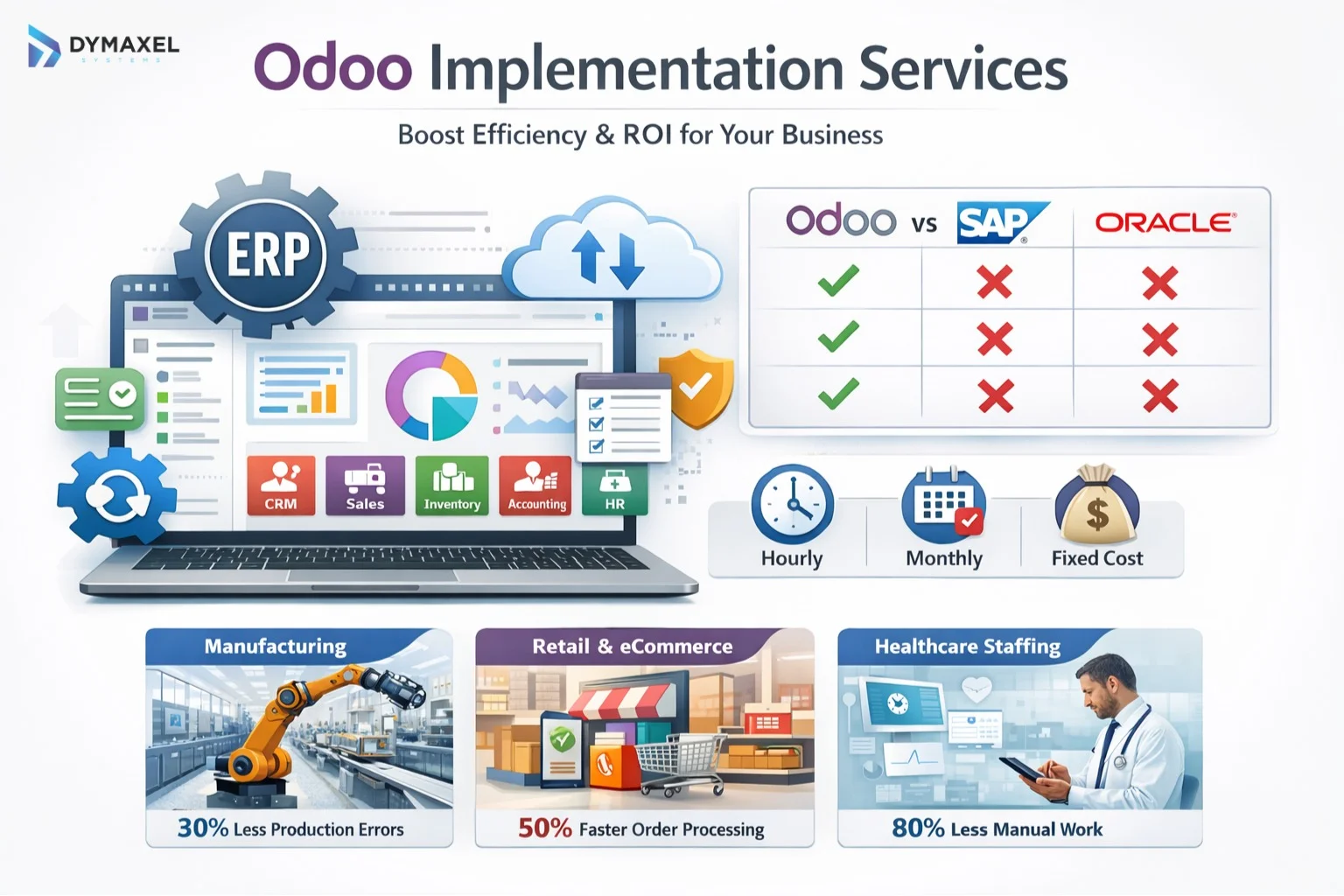
Odoo Implementation Services: Efficient, Customized, and ROI-Focused Dymaxel ensures Odoo ERP is implemented seamlessly, customized for your industry, integrated with your systems, and optimized to maximize operational efficiency.
Call-to-Action: Schedule a consultation with Dymaxel’s certified Odoo ERP experts today.
What Are Odoo Implementation Services?
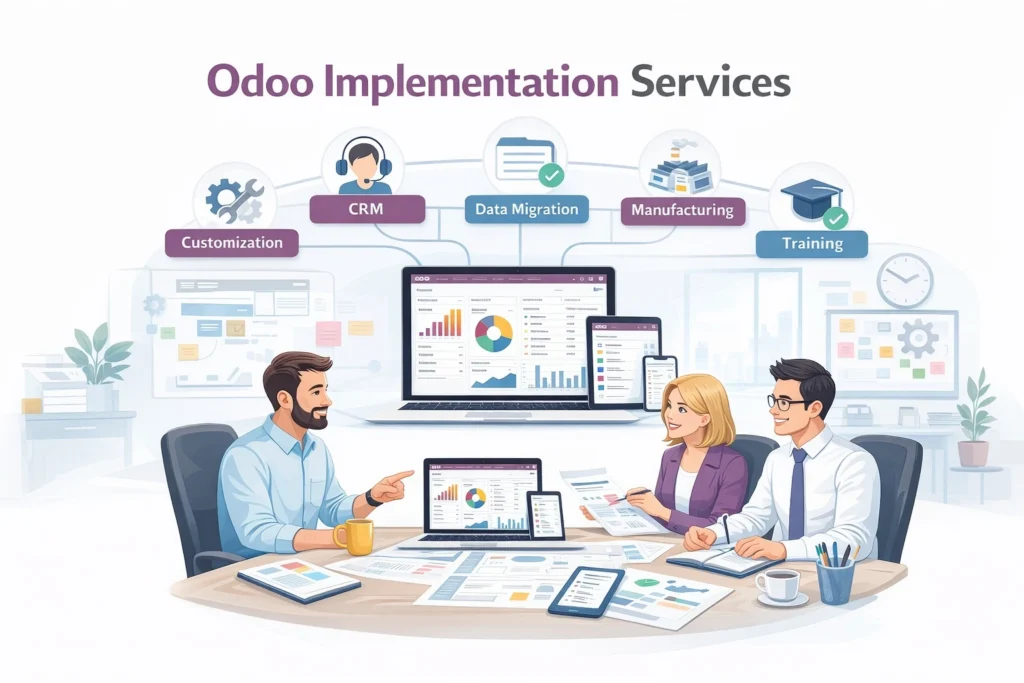
Odoo Implementation Services encompass the full lifecycle of ERP deployment, including:
- Consulting & business analysis
- Module selection & configuration
- Custom module development
- Data migration from legacy systems
- Third-party integrations
- Testing and training
- Post-launch support and optimization
Detailed Breakdown:
- Consulting & Strategy: Analyze workflows, identify bottlenecks, define KPIs, and create a requirements blueprint.
- Module Selection & Configuration: Choose modules like CRM, Accounting, Inventory, Manufacturing, HR, Marketing, eCommerce, Project Management, and Helpdesk; configure roles, permissions, and workflows.
- Custom Module Development: Build modules tailored to business-specific processes, automate repetitive tasks, and create dashboards for insights.
- Data Migration: Safely migrate data from SAP, Oracle, QuickBooks, NetSuite, or spreadsheets while maintaining integrity.
- Integration: Connect Odoo with payment gateways, logistics, eCommerce platforms, BI tools, and other business software.
- Testing & QA: Perform unit, integration, and user acceptance testing to ensure a fully functional system.
- User Training & Go-Live: Train employees and deploy the system across the organization.
- Post-Implementation Support: Monitor performance, optimize workflows, and provide troubleshooting.
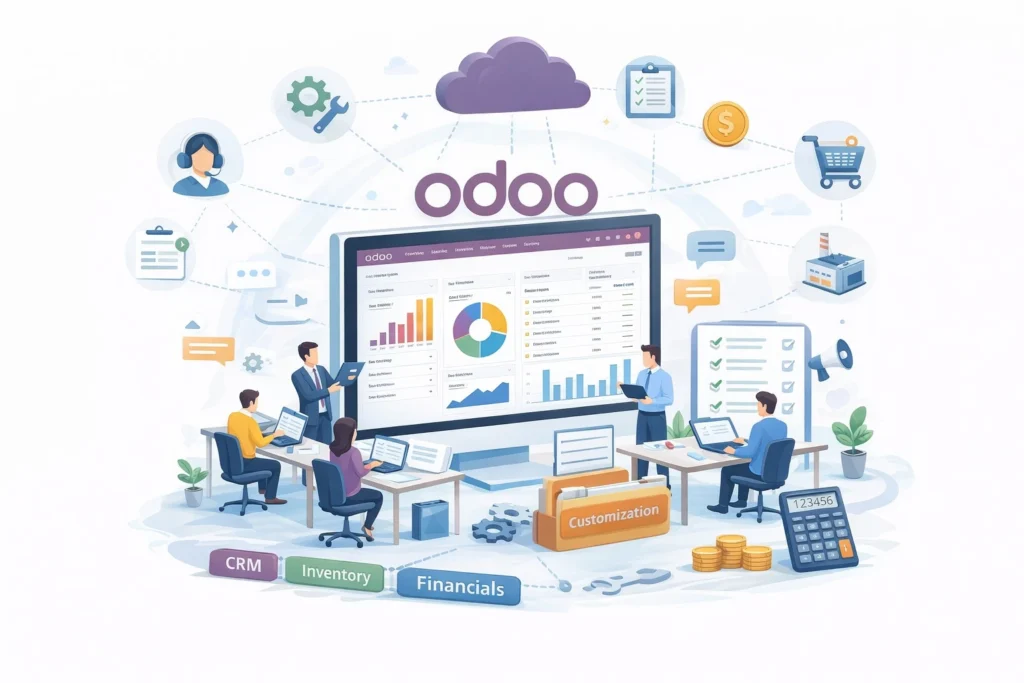
Why Businesses Choose Odoo ERP Implementation
1. All-in-One Platform
Odoo centralizes sales, accounting, HR, inventory, manufacturing, and marketing, eliminating silos.
Example: A sales order automatically updates inventory and accounting in real-time, reducing manual errors.
2. Modular Architecture
Install only the modules you need and scale as business requirements grow.
Example: Start with CRM, POS, and Inventory; add Manufacturing or Marketing Automation later.
3. Open-Source Flexibility
Odoo can be customized extensively for industry-specific workflows, dashboards, and reports.
Example: Automate quality control in manufacturing or invoice reminders for professional services.
4. Lower Total Cost of Ownership
Odoo offers affordable licensing and faster deployment compared to SAP and Oracle.
5. Scalable Infrastructure
Supports businesses from startups to large enterprises and grows with your operations.
Odoo vs SAP vs Oracle: Comparison Table
| Feature / Criteria | Odoo ERP | SAP ERP | Oracle ERP |
| Cost | Low TCO, flexible pricing | High license & implementation cost | High license & implementation cost |
| Deployment | Cloud, On-Premise, Hybrid | Mostly On-Premise | Cloud & On-Premise |
| Ease of Use | Intuitive, user-friendly | Complex, requires training | Moderate complexity |
| Customization | Fully customizable | Limited, expensive | Customizable but costly |
| Modular Architecture | Add modules anytime | Monolithic, large modules required | Modular, complex integration |
| Integration | Easy via APIs & modules | Often needs middleware | Moderate, may require consulting |
| Scalability | SMBs & Enterprises | Enterprise-focused | Enterprise-focused |
| Support & Community | Strong global partner network | Official support | Official support |
| Implementation Time | 2–6 months | 6–18 months | 6–18 months |
| Industry Coverage | Wide range | Enterprise-heavy | Enterprise-heavy |
Detailed Benefits of Odoo ERP Implementation Services
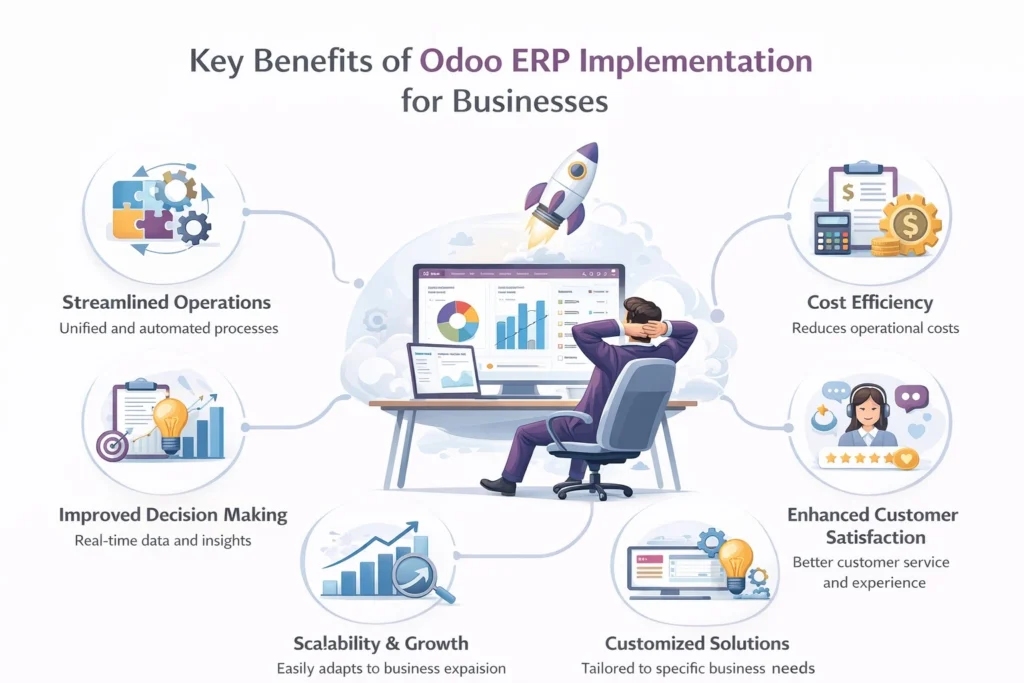
- Streamlined Processes: Reduce manual tasks and errors.
- Real-Time Insights: Dashboards and analytics enable informed decisions.
- Custom Workflows: Modules tailored for industry-specific processes.
- Scalability: Add modules and users as business grows.
- Integration: Connect Odoo seamlessly to external tools.
- Cost Efficiency: Lower implementation, licensing, and maintenance costs.
- Faster Decision Making: Access accurate, real-time data.
- Enhanced Collaboration: Unified platform improves communication.
- ROI-Focused: Measureable operational efficiency from day one.
Industry Examples:
- Manufacturing: Production errors reduced by 30%
- Retail & eCommerce: Order accuracy improved by 50%
- Healthcare Staffing: Manual reporting reduced by 80%
- Finance & Professional Services: Automated billing and client management
Odoo Implementation Process: Step-by-Step
Step 1: Discovery & Analysis
- Stakeholder workshops
- Map workflows, identify inefficiencies
- Define KPIs and objectives
Step 2: Project Planning
- Define scope, timeline, and milestones
- Assign roles and responsibilities
- Risk assessment and mitigation
- Budget allocation
Step 3: Module Configuration
- Configure CRM, Accounting, Inventory, Manufacturing, HR, eCommerce, Marketing
- Assign roles, permissions, and workflows
Step 4: Custom Development
- Build custom modules for industry-specific needs
- Automate workflows
- Develop dashboards and reports
Step 5: Data Migration
- Extract, clean, transform, and validate data
- Migrate from SAP, Oracle, QuickBooks, NetSuite, spreadsheets
Step 6: Integration
- Connect with eCommerce, payment gateways, logistics, BI tools
- Ensure real-time synchronization
Step 7: Testing & QA
- Unit, integration, and user acceptance testing
- Performance and stress testing
- Issue tracking and resolution
Step 8: User Training & Go-Live
- Role-based training
- Pilot launch
- Full deployment with monitoring
Step 9: Post-Implementation Support
- System monitoring and optimization
- Module updates and new feature deployment
- Ongoing troubleshooting and helpdesk support
Community vs Enterprise Edition
- Community: Free, basic modules, self-hosted
- Enterprise: Paid, advanced modules, cloud hosting, Odoo Studio customization
Most businesses choose Enterprise for full functionality, professional support, and scalability.
Industries That Benefit
- Manufacturing: Production scheduling, BOM, quality control
- Retail & eCommerce: POS, inventory, online store integration
- Healthcare Staffing: Streamlined reporting, compliance
- Finance & Professional Services: Billing, reporting, client management
- Logistics & Distribution: Warehouse and fleet optimization
- Construction: Project management, procurement, HR
- Hospitality & Education: Reservations, HR, operations
Hiring Models
- Hourly-Based Engagement: Pay for expertise as needed
- Monthly Subscription: Fixed monthly engagement
- Fixed-Cost Projects: Full implementation for pre-agreed budget
Case Studies & Success Metrics
- Manufacturing: Production errors reduced by 30%
- Retail: Order fulfillment accuracy improved by 50%
- Healthcare Staffing: Manual reporting reduced by 80%
- Finance: Automated billing and client management
Frequently asked questions
What is Odoo ERP Implementation?
End-to-end deployment, configuration, and customization of Odoo to align with business workflows and processes.
How long does implementation take?
Typically 2–6 months depending on business size, modules, and customizations.
How much does it cost?
$5,000–$50,000+ depending on modules, users, and integration complexity.
Can data be migrated from other ERPs?
Yes, Dymaxel supports migration from SAP, Oracle, QuickBooks, NetSuite, and spreadsheets.
Can Odoo be customized?
Yes. Custom modules, workflows, and reports can be developed for unique business processes.
Can Odoo integrate with other business software?
Yes. Integration with eCommerce platforms, payment gateways, logistics, and BI tools is fully supported.
Which edition is right for my business?
Community: Free, basic modules, self-hosted. Enterprise: Paid, advanced modules, cloud hosting, professional support.
Why hire a certified Odoo partner?
Ensures smooth deployment, minimal downtime, accurate configuration, and maximum ROI.
Which industries benefit most?
Manufacturing, Retail & eCommerce, Logistics, Healthcare, Finance, Construction, Education, and Hospitality.
How is ROI measured?
Reduction in manual tasks, error prevention, improved reporting, time savings, and increased productivity across departments.
Planning an Odoo project?
Get a fixed-price scope for your Odoo rollout in a free 45-minute meeting.
Keep reading
Dymaxel vs. Bista Solutions: which Odoo partner fits your project?
Bista is a larger, award-winning Gold partner built for scale. Dymaxel is a smaller Silver partner built for closer, SMB-sized delivery. Here is how to choose.
Odoo ERPTop Odoo implementation companies in 2026
The right Odoo partner depends on your project size more than any ranking. Here is how the main implementation companies differ, with real reference counts.
Odoo ERPOdoo Community vs Enterprise: what's the difference?
Community is free and open source; Enterprise adds full Accounting, Studio, mobile apps, hosting and upgrades. Here is what differs and how to choose.