





What Is Odoo ERP? Complete Guide to Odoo Business Software
Businesses today rely on multiple systems to manage daily operations. Sales teams use CRM tools, finance departments rely on accounting software, warehouses operate inventory systems, and HR teams manage employee data separately.
When these tools operate independently, businesses often struggle with disconnected workflows, duplicated data, and limited visibility across departments.
This is where ERP (Enterprise Resource Planning) systems become essential.
ERP platforms bring all business processes into a single unified system. Among the many ERP solutions available today, Odoo ERP has become one of the fastest-growing business management platforms due to its flexibility, modular design, and cost-effective implementation.
In this guide, we explain what Odoo is, how it works, its key features, modules, benefits, pricing structure, and how businesses implement Odoo successfully.
What Is Odoo?
Odoo is an open-source ERP (Enterprise Resource Planning) platform designed to help businesses manage their operations from one centralized system.
Instead of using separate software for accounting, CRM, inventory, HR, marketing, and project management, Odoo integrates these functions into a single platform.
Odoo includes hundreds of applications that allow organizations to manage nearly every aspect of their operations.
Common Odoo applications include:
Customer Relationship Management (CRM)
- Sales management
- Accounting and finance
- Inventory and warehouse management
- Manufacturing
- Human resources
- Marketing automation
- eCommerce
- Website management
- Project management
Because of its modular architecture, businesses can start with a few applications and expand the system as their operations grow.
The History of Odoo
Odoo was founded in 2005 by Fabien Pinckaers in Belgium.
The platform originally launched under the name TinyERP, aiming to provide businesses with a more accessible alternative to traditional ERP systems.
It was later renamed OpenERP, and in 2014 the company rebranded the platform as Odoo.
Today, Odoo is one of the most widely used ERP systems globally, with:
- millions of users worldwide
- thousands of implementation partners
- hundreds of integrated applications
- regular yearly product updates
The platform continues to evolve, introducing new features and improvements in every major release.
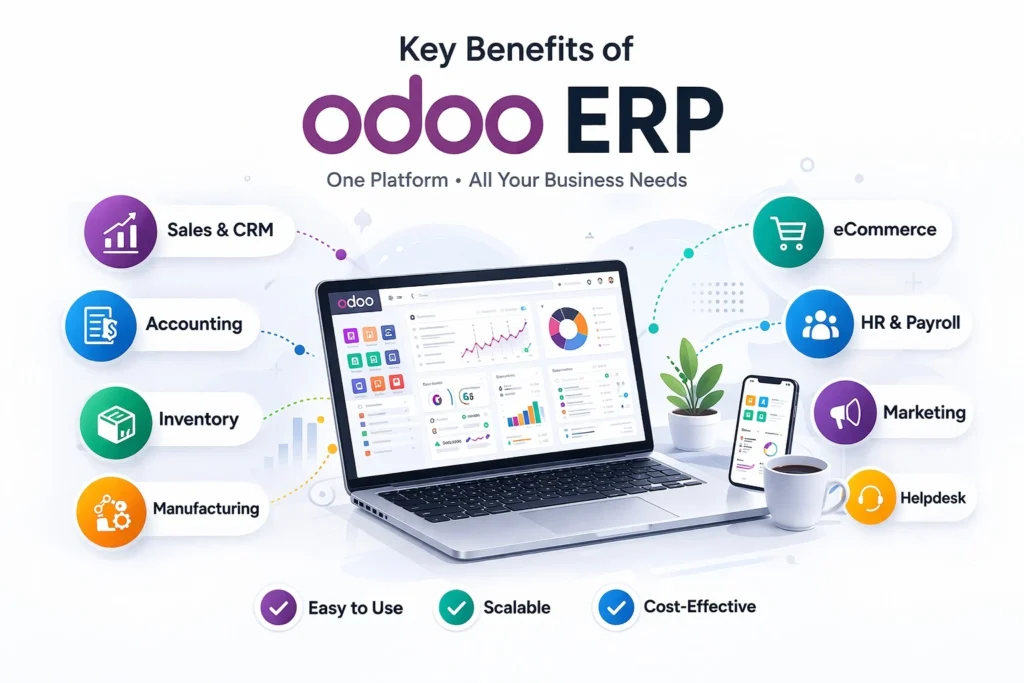
Why Businesses Choose Odoo ERP
Companies choose Odoo because it offers the functionality of enterprise ERP systems while remaining flexible and scalable.
All-in-One Business Platform
Odoo consolidates multiple business functions into a single system. Sales, accounting, operations, HR, and marketing can all operate within one platform.
This eliminates data silos and improves collaboration between departments.
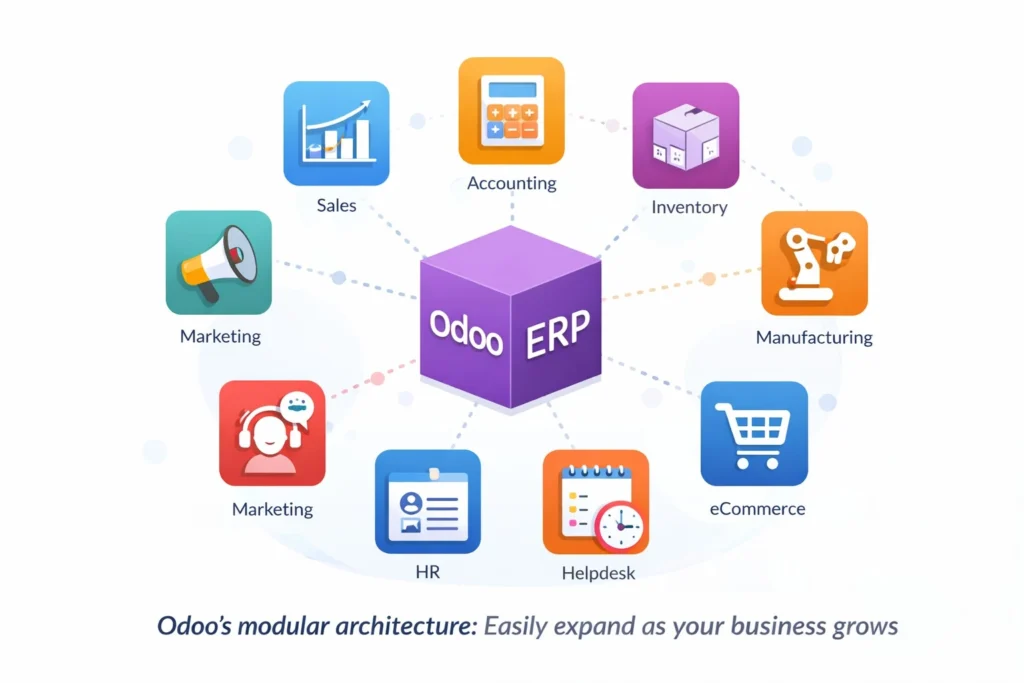
Modular Architecture
One of Odoo’s strongest advantages is its modular design.
Businesses can install only the modules they need. As the company grows, additional modules can be added without replacing the system.
Open-Source Flexibility
Odoo’s open-source architecture allows developers to customize workflows and build new modules that match specific business processes.
This makes the system adaptable to many industries.
Lower Total Cost of Ownership
Compared to traditional ERP systems like SAP or Oracle, Odoo often provides a lower implementation and maintenance cost.
Companies benefit from:
- lower licensing costs
- faster implementation
- scalable infrastructure
- customizable modules
Scalable for Growing Companies
Odoo supports companies from startup stage to enterprise scale. Businesses can begin with basic modules and gradually expand the system as operational complexity increases.
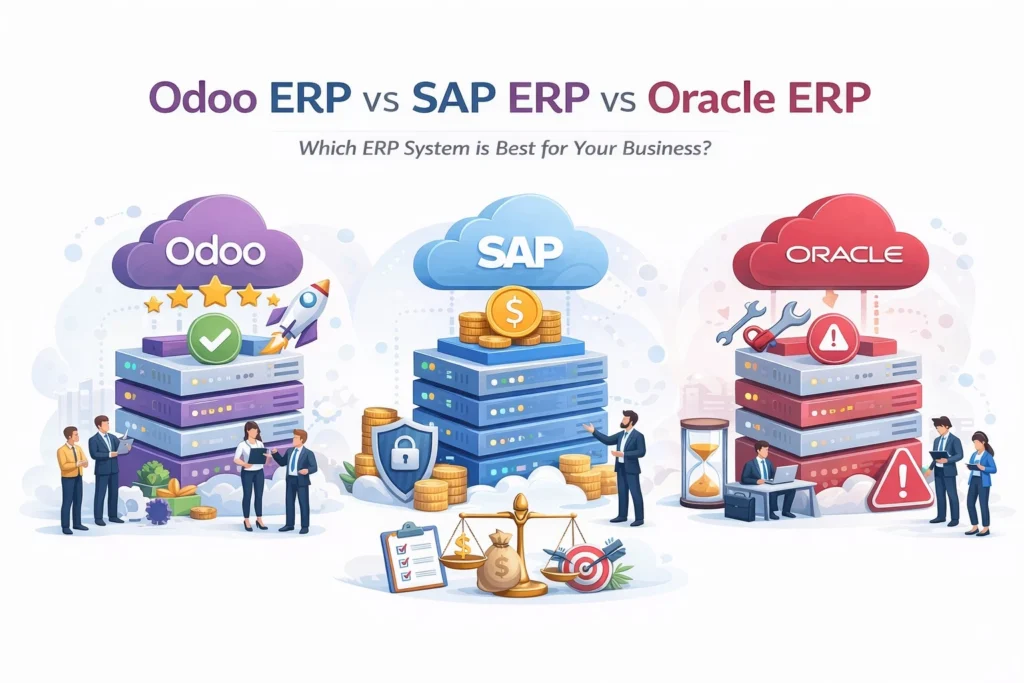
Odoo vs SAP vs Oracle: Comparison Table
| Feature / Criteria | Odoo ERP | SAP ERP | Oracle ERP |
|---|---|---|---|
| Cost | Low TCO, flexible pricing | High license & implementation cost | High license & implementation cost |
| Deployment | Cloud, On-Premise, Hybrid | Mostly On-Premise, Cloud available | Cloud & On-Premise |
| Ease of Use | User-friendly interface, intuitive | Complex UI, requires extensive training | Moderate complexity, technical expertise needed |
| Customization | Highly customizable (open-source) | Limited, expensive customizations | Customizable but costly and complex |
| Modular Architecture | Install only needed apps, add modules anytime | Monolithic, large modules required | Modular, but requires integration planning |
| Integration | Easy via APIs and custom modules | Complex, often needs middleware | Moderate, may require consulting |
| Scalability | Scales with SMBs and Enterprises | Enterprise-focused | Enterprise-focused |
| Support | Strong global community, partner network | Official support, smaller community | Official support, smaller community |
| Implementation Time | 2–6 months (typical) | 6–18 months | 6–18 months |
| Industry Flexibility | Wide range of industries | Enterprise-heavy, fewer SMB options | Enterprise-heavy, fewer SMB options |
Key Takeaway:
- Odoo provides affordable, flexible, and faster-to-deploy ERP solutions, making it ideal for SMBs and enterprises alike.
- SAP and Oracle are better suited for large enterprises with huge budgets, but Odoo matches their capabilities in many areas with less cost and complexity.
- This comparison helps decision-makers see why Odoo is often the better choice for companies seeking efficiency and scalability.
Key Features of Odoo ERP
Odoo offers a wide range of business applications that integrate seamlessly with one another.
CRM and Sales Management
Odoo CRM helps businesses track leads, manage customer relationships, and automate sales processes.
Key features include:
- sales pipeline tracking
- lead scoring and qualification
- automated follow-ups
- sales forecasting
- customer interaction history
These tools help sales teams convert leads more efficiently.
Accounting and Financial Management
The accounting module provides businesses with real-time financial visibility.
Features include:
- invoicing and billing
- bank reconciliation
- expense management
- tax management
- financial reporting
Because accounting integrates with sales and inventory, financial data remains accurate and synchronized.
Inventory and Warehouse Management
Odoo allows businesses to manage warehouse operations and inventory movements efficiently.
Capabilities include:
- real-time stock tracking
- barcode scanning
- automated stock replenishment
- multi-warehouse management
- order fulfillment automation
These features help businesses maintain accurate inventory levels and streamline logistics.
Manufacturing Management
Manufacturing companies can manage production processes with Odoo’s manufacturing module.
Features include:
- bill of materials (BOM)
- production orders
- work center management
- production planning
- quality control
Manufacturers gain full visibility into production workflows and operational performance.
eCommerce and Website Builder
Odoo includes built-in tools for building websites and online stores.
Businesses can create:
- fully functional eCommerce stores
- landing pages
- customer portals
- online product catalogs
All transactions automatically integrate with sales, inventory, and accounting modules.
Marketing Automation
Odoo marketing tools allow businesses to run automated campaigns and track marketing performance.
Capabilities include:
- email marketing
- customer segmentation
- lead nurturing campaigns
- campaign performance analytics
- automated marketing workflows
This helps organizations attract and convert customers more efficiently.
Odoo Apps Ecosystem
One of the biggest advantages of Odoo is its large ecosystem of applications.
The Odoo App Store contains hundreds of modules designed to extend the platform.
Popular applications include:
- CRM
- Sales
- Accounting
- Inventory
- Manufacturing
- HR and payroll
- Project management
- Helpdesk support
- Marketing automation
- eCommerce
- Website builder
These applications integrate seamlessly, allowing companies to run their entire operations within a unified system.
Odoo Community vs Odoo Enterprise
Odoo provides two main versions of its software.
Odoo Community Edition
The Community edition is open-source and free to use.
Features include:
- basic ERP modules
- access to source code
- flexibility for custom development
However, businesses must handle hosting, updates, and maintenance themselves.
Odoo Enterprise Edition
The Enterprise edition provides advanced features and official support.
Benefits include:
- advanced reporting tools
- enterprise accounting features
- Odoo Studio customization tools
- mobile applications
- cloud hosting options
Most companies choose the Enterprise version because it offers additional functionality and support.
Benefits of Odoo ERP for Businesses
Implementing Odoo provides several operational advantages.
Improved Operational Efficiency
Automation of repetitive tasks allows employees to focus on strategic work rather than manual processes.
Better Business Visibility
Integrated data across departments provides leadership with real-time operational insights.
Reduced Software Complexity
Instead of managing multiple disconnected tools, businesses operate from a single platform.
Scalable Infrastructure
Odoo grows with the company, allowing new modules and capabilities to be added over time.
Faster Decision Making
Real-time dashboards and analytics help management teams make informed decisions quickly.
Industries That Use Odoo
Odoo is used across a wide range of industries because it can be customized for specific workflows.
Common industries include:
- manufacturing
- logistics and distribution
- retail and eCommerce
- healthcare
- construction
- professional services
- hospitality
- education
Industry-specific modules and custom development allow businesses to tailor the system to their operational requirements.
Odoo Integrations
Odoo integrates with many third-party systems and services.
Common integrations include:
- payment gateways
- shipping and logistics platforms
- eCommerce platforms
- external accounting tools
- cloud storage solutions
- business intelligence tools
Integration can be achieved through APIs, custom modules, or middleware platforms.
Odoo Pricing and Cost Considerations
Odoo pricing varies depending on the edition and modules used.
Factors influencing cost include:
- number of users
- modules installed
- hosting infrastructure
- customization requirements
- implementation services
While the Community version is free, most companies choose the Enterprise edition due to its extended capabilities.
Compared to traditional ERP systems, Odoo typically offers a lower total cost of ownership, making it attractive for small and mid-sized companies.
Odoo Implementation Process
Successful ERP implementation requires a structured approach.
Typical Odoo implementation includes the following stages.
Business Process Analysis
Understanding existing workflows and identifying areas where automation can improve efficiency.
ERP Planning and Module Selection
Selecting the most appropriate modules based on business needs.
Customization and Development
Building custom features or modules when standard functionality does not fully match business requirements.
Data Migration
Transferring historical data from legacy systems into Odoo.
Testing and Validation
Ensuring all modules function correctly before deployment.

User Training and Go-Live
Training employees and launching the system organization-wide.
Ongoing Support and Optimization
Monitoring system performance and continuously improving workflows.
Why Businesses Choose Dymaxel for Odoo Implementation
Implementing ERP software requires both technical expertise and deep understanding of business operations.
Dymaxel Systems helps organizations implement and customize Odoo ERP to support their long-term growth.
Our services include:
- Odoo consulting and strategy
- ERP implementation and migration
- custom module development
- third-party integrations
- AI-powered automation solutions
- long-term support and system optimization
By aligning technology with business processes, Dymaxel enables organizations to streamline operations, reduce manual work, and improve decision-making.